December 19, 2025
Shared Light in the Dark: Major Religious Holidays of December
By Filipe Pedroso.
Hinduism: Gita Jayanti
Date: December 1, 2025
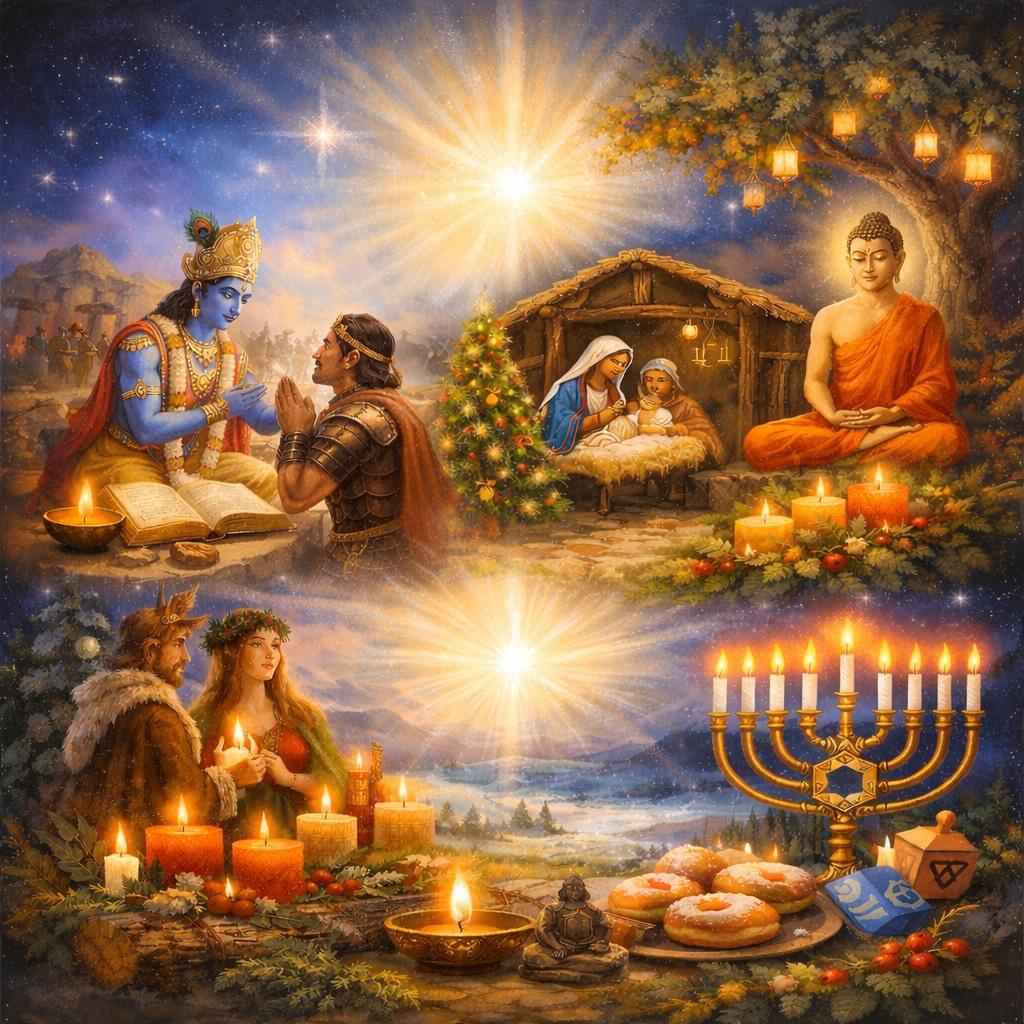
Gita Jayanti commemorates the day the Bhagavad Gita—one of Hinduism’s most sacred and influential texts—was revealed. According to tradition, Lord Krishna imparted the teachings of the Gita to the warrior Arjuna on the battlefield of Kurukshetra at a moment of deep moral crisis. The text addresses duty (dharma), devotion (bhakti), selfless action (karma), and spiritual knowledge (jnana), making it foundational to Hindu philosophy.
How is Gita Jayanti celebrated:
Hindus observe Gita Jayanti through scripture readings, lectures, group discussions, chanting, meditation, and prayer. Many temples hold recitations of the entire Bhagavad Gita or focus on key verses that explore life’s purpose, ethical action, and devotion to God. The day is reflective rather than festive, emphasizing inner clarity, righteous living, and spiritual wisdom.
Buddhism: Bodhi Day
Date: December 8, 2025
Bodhi Day marks the day Siddhartha Gautama attained enlightenment under the Bodhi tree and became the Buddha. This moment represents the foundation of Buddhism and the possibility of awakening for all beings.
How is Bodhi Day celebrated:
Observances vary by tradition, but many Buddhists meditate, chant sutras, study the Dharma, and perform acts of compassion. Some decorate ficus (Bodhi) trees with lights and symbols. The day is quiet and reflective, focusing on mindfulness, wisdom, and the alleviation of suffering.
Judaism: Hanukkah (Festival of Lights)
Dates: Evening of December 14 through evening of December 22, 2025
Hanukkah is a major Jewish holiday commemorating the rededication of the Second Temple in Jerusalem after the Maccabean revolt against religious oppression in the 2nd century BCE. Central to the holiday is the miracle in which a small amount of sacred oil burned for eight days when it should have lasted only one.
How is Hanukkah celebrated:
Hanukkah is observed by lighting the menorah—one candle each night for eight nights—accompanied by blessings and songs. Families gather to eat foods fried in oil, such as latkes and sufganiyot, and children often play dreidel games and receive small gifts. The holiday emphasizes religious freedom, perseverance, and faith.
Pagan / Earth-Based Traditions: Yule (Winter Solstice)
Date: December 21, 2025
Yule marks the Winter Solstice, the shortest day and longest night of the year in the Northern Hemisphere. It is a central observance in many Pagan, Wiccan, and Earth-based spiritual traditions, symbolizing the rebirth of the sun and the return of light.
How is Yule celebrated:
Celebrations often include lighting candles or fires, decorating with evergreen plants, honoring nature, and reflecting on cycles of death and renewal. Rituals focus on hope, balance, and the promise of longer days ahead.
Christianity: Christmas
Date: December 25, 2025
Christmas is one of the most important holidays in Christianity, commemorating the birth of Jesus Christ, whose life and teachings are foundational to the faith and who is considered the Savior of humanity. The holiday centers on the themes of incarnation, divine love, humility, and redemption.
How is Christmas celebrated:
Christians celebrate Christmas with church services, prayers, scripture readings, and hymns that recount the Nativity story. Many attend midnight Mass or Christmas Day services. The holiday is also marked by family gatherings, charitable giving, and cultural traditions such as decorating Christmas trees, exchanging gifts, and sharing meals. The season is preceded by Advent, a period of spiritual preparation and anticipation.
What These Holidays Have in Common
Despite originating in vastly different cultures and belief systems, these holidays share remarkable similarities:
• Wisdom and Illumination:
Whether it is the enlightenment of the Buddha, the divine teachings of the Bhagavad Gita, the birth of Christ, the miracle of Hanukkah’s light, or the rebirth of the sun at Yule, each holiday centers on illumination—spiritual, moral, or cosmic.
• Moral Renewal and Right Action:
These observances call followers to live better lives: acting with compassion, faith, courage, humility, and responsibility. The emphasis is not only on belief, but on how one lives.
• Hope During Darkness:
Occurring during the darkest days of the year, each holiday affirms that darkness—whether literal, spiritual, or moral—is not permanent. Light, understanding, and renewal will return.
• Continuity Across Generations:
Each tradition connects modern communities to ancient stories and teachings that have endured for centuries, reinforcing identity, shared values, and collective memory.
Closing Thought
Taken together, Christianity, Judaism, Buddhism, Hinduism, and Earth-based traditions all use December to pause, reflect, and re-orient toward what matters most. Though the languages and symbols differ, the message resonates across faiths: when the world feels darkest, wisdom, light, and renewal emerge.
⸻
Author's note: Islam was not included because Islam follows a lunar calendar that is about 11 days shorter than the Gregorian calendar. As a result, major Muslim holidays—such as Eid al-Fitr and Eid al-Adha—shift earlier each year and do not fall in December in 2025.
I have done my best to make this article as accurate as possible. Any inadvertent errors or misrepresentations regarding anyone’s faith were unintentional. Please feel free to contact me if you notice any mistakes or oversights. Thank you.
⸻
About the author:
Filipe Pedroso, Esq. is an accomplished attorney, innovative entrepreneur, inventor, and dedicated public servant based in Bridgewater, New Jersey. A four-time elected Councilman in Bridgewater (NJ), he championed fiscal responsibility, smart municipal governance, fiscal discipline, and quality of life issues for residents. He also founded and led grassroots efforts such as Preserve Bridgewater, opposing overdevelopment projects and playing a substantial role in protecting the town’s character.
Filipe earned his Juris Doctor from Seton Hall University School of Law and a B.S. in Biochemistry from Rutgers University. He has earned numerous professional awards for client service and attorney performance while working as an attorney, and served as a co-host of a biweekly legal television show.
As a technology founder and CEO, Filipe pioneered Giftapart, Inc., the world's first social e-commerce platform, and VoterMaker, Inc., the world's most comprehensive political engagement and campaign technology platform that has been used to streamline voter outreach and campaign management. Filipe is a technology inventor and innovator. He has earned patents in the United States and internationally, and is recognized as the inventor of social e-commerce and the only gifting system that allow gifts to be purchased in the user-specified order.
Beyond law and technology, Filipe has been active in business development, media, and civic leadership, contributing to regional boards, committees, and community causes. He and his wife Liana, a corporate communications professional and founder of HashtagPR.Agency, are raising their four children in Bridgewater while continuing to pursue entrepreneurial, civic, and technological ventures.
To contact Filipe, please use the Contact form.